
100% Foreign Ownership in Thailand: What Investors Need to Know in 2026
By ATA Editorial
Foreigners can own 100% of a company in Thailand, but only through specific routes. Without one of them, foreign ownership in restricted businesses is capped at 49%. The three routes are BOI promotion, the Treaty of Amity (for U.S. citizens and U.S.-owned companies) and a Foreign Business License (FBL). This guide explains how each route works, what limits apply, and which rules changed in 2025 and 2026.
What Is the 49% Foreign Ownership Limit in Thailand?
A Thai limited company limits foreign business ownership to a maximum of 49% in businesses restricted under the Foreign Business Act (FBA). Thai shareholders must hold the remaining 51%.
The cap exists because the FBA treats any company with 50% or more foreign shares as a foreign company. A foreign company needs special permission to run restricted activities, which include many service, agriculture and trade businesses. Businesses outside the FBA lists are not subject to this cap.
What Are the Three Ways to Own 100% of a Business in Thailand?
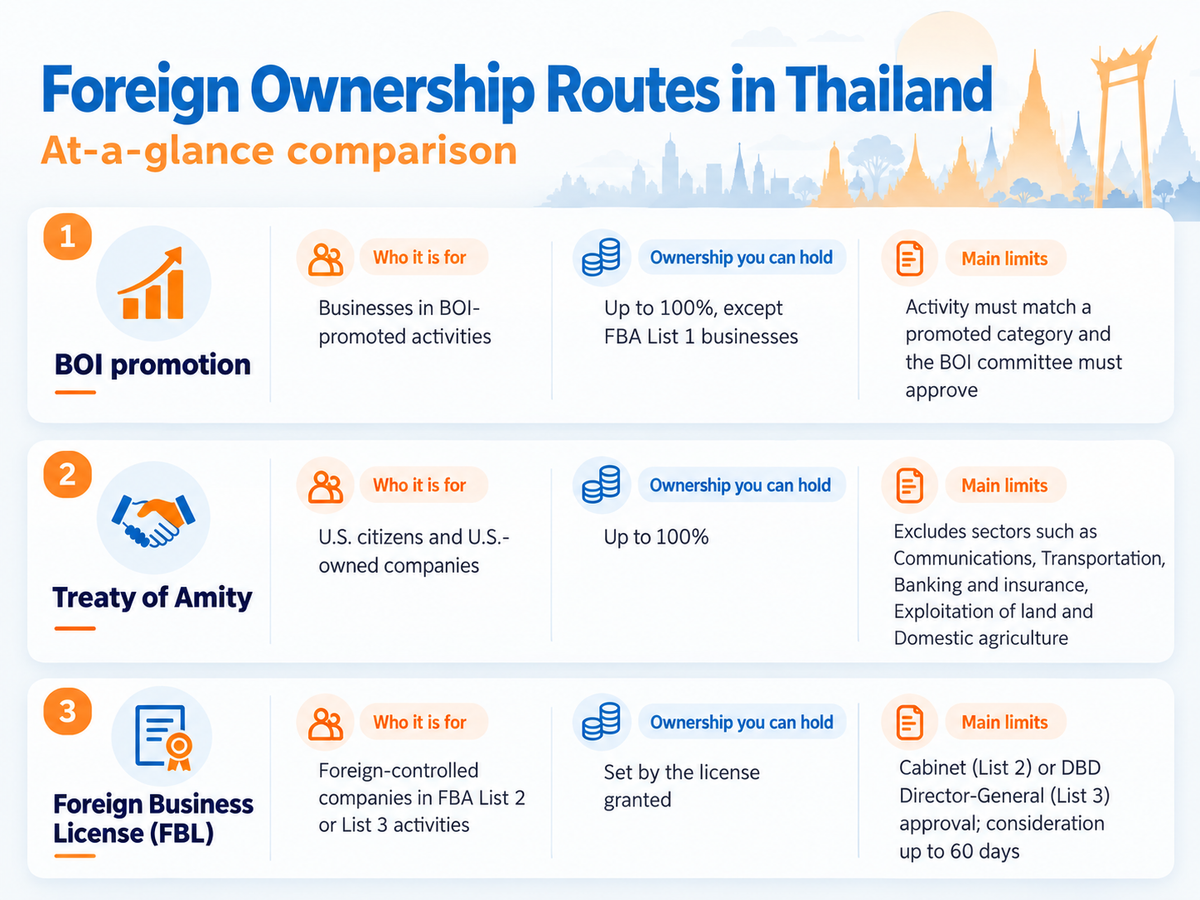
The three routes are BOI promotion, the Treaty of Amity and a Foreign Business License. They suit different situations and have different limits.
- BOI promotion: This route is for businesses in BOI-promoted activities. You can hold up to 100% of the shares, except in FBA List 1 businesses. The activity must match a promoted category, and the BOI committee must approve it.
- Treaty of Amity: This route is for U.S. citizens and U.S.-owned companies. You can hold up to 100% of the shares, but the treaty does not cover every sector. Activities such as communications, transport, banking and the exploitation of land or natural resources are excluded, so check the treaty's conditions for your activity before relying on it.
- Foreign Business License (FBL): This route is for foreign-controlled companies in FBA List 2 or List 3 activities. The ownership you can hold is set by the license granted. List 2 activities need approval from the Minister of Commerce with Cabinet approval. List 3 activities need approval from the DBD Director-General with the Foreign Business Commission's approval. The decision is due within 60 days from filing, and this can be extended in some cases.
- A Representative Office is an optional extra, not a route to ownership. It is for non-revenue work only.
How Does BOI Promotion Allow 100% Foreign Ownership in Thailand?
BOI promotion from the Thailand Board of Investment lets foreigners hold 100% of the shares in a promoted company. The exceptions are businesses on FBA List 1 and those restricted by other specific laws.
To qualify, your activity must match a promoted category, such as technology, advanced manufacturing, renewable energy or a regional headquarters. The BOI committee then approves your business plan.
What Tax and Import Duty Incentives Does BOI Promotion Offer?
BOI promotion gives a corporate income tax exemption of 3 to 8 years by category, and up to 13 years in total for the highest-priority activities. Category A4 gets 3 years, A3 gets 5 years, and A1 and A2 get 8 years, each plus merit-based extensions. The top A1+ category gets 10 to 13 years.
Promoted companies also receive import duty exemptions on machinery and on raw materials used for export production.
What Are the BOI Rules on Hiring Foreign Employees?
BOI-promoted companies must pay foreign employees on contracts of six months or more a minimum monthly salary that depends on the role. The minimums are THB 150,000 for executives, THB 75,000 for managers, engineers, IT specialists and researchers (THB 50,000 with a relevant bachelor's degree), THB 50,000 for operation staff and THB 35,000 for operators.
Manufacturers with more than 100 employees must also keep at least 70% Thai staff. Smaller manufacturers and service businesses have no minimum Thai staff ratio, and contracts shorter than six months are exempt from the salary and ratio rules.
The rules apply from 1 October 2025 for BOI certificates issued on or after 5 June 2025, and from 1 January 2026 for certificates issued earlier.
What Are the BOI Rules on Land Ownership?
BOI-promoted companies can generally own land for their promoted activities, but from 1 September 2025, the BOI no longer grants this privilege to new applicants in six specified manufacturing categories. These include non-ferrous metal rolling, drawing, casting and forging; steel products or steel parts; metal products and parts for industrial use; other industrial metal products and parts; industrial chemicals; and plastic products and parts for industrial use.
Existing promoted companies may still qualify for land ownership privileges if they have at least three BOI-promoted projects under the same legal entity between 2011 and 2025, with combined approved investment of at least THB 5 billion, excluding land costs and working capital.
In addition, new applicants in bag manufacturing, furniture or furniture parts manufacturing, and printing activities must have Thai natural persons holding at least 51% of the registered capital. This Thai-majority shareholding requirement does not apply to projects located in Border Special Economic Development Zones.
Who Can Use the Treaty of Amity to Own 100% of a Thai Company?
The Treaty of Amity is available to U.S. citizens and to companies with majority American ownership. It allows 100% ownership, including in sectors normally restricted to foreigners, without Thai nominee shareholders. Green card holders do not qualify unless they are also U.S. citizens.
The treaty does not cover communications, domestic transport, banking and insurance underwriting, land ownership, mining and natural resources, or defense and armaments.
The usual process is to register a Thai limited company with the Department of Business Development (DBD), obtain certification from the U.S. Embassy, then register that certification with the DBD.
How Does a Foreign Business License Work in Thailand?
A Foreign Business License (FBL) is official permission for a foreign-controlled company to run a business that the Foreign Business Act (FBA) restricts. You need one if your business is on FBA List 2 or List 3 and you don't qualify for BOI promotion or the Treaty of Amity.
Which businesses need an FBL?
The FBA groups restricted businesses into three lists. List 1 businesses are closed to foreigners and cannot be licensed. List 2 covers businesses linked to national security, culture and traditions, or natural resources and the environment. List 3 covers businesses where Thai companies are not yet considered ready to compete with foreign ones, which includes many professional, retail, construction and restaurant activities.
Who approves the license?
For List 2 activities, the Cabinet decides, through the Minister of Commerce. For List 3 activities, the Director-General of the Department of Business Development (DBD) decides. The DBD states that the consideration period must be completed within 60 days.
Which services no longer need a license?
A Thai government regulation published in the Royal Gazette on 28 August 2026 removed the permission requirement for seven service categories. These are Type 1 telecommunications services, treasury center services, administrative, HR and IT services between related companies, domestic debt guarantees between related companies, space leasing for electronic financial equipment and employee vending machines, petroleum drilling services under direct contracts, and certain securities and derivatives activities.
Is a Representative Office Required for Foreign Business Ownership in Thailand?
No. A Representative Office is optional, and it is not a way to own a Thai company. It is an office of a foreign company that does non-revenue work for its head office or affiliates.
The permitted work includes reporting on Thai business trends, sourcing goods or services in Thailand, checking the quality and quantity of goods, advising on head office products, and preparing information on new products or services.
A Representative Office cannot earn income or trade in Thailand, so a business that plans to earn revenue should use BOI promotion, the Treaty of Amity or an FBL instead. Applications are handled through the DBD.
What Has Changed in Thailand's Foreign Ownership Rules Recently?
Thailand tightened BOI land and hiring rules in 2025, tightened nominee checks in 2026 and exempted seven services from foreign business permission in August 2026.
- BOI land and ownership rules: The BOI removed land ownership privileges for new applicants in six manufacturing sectors. It also requires Thai shareholders to hold more than 50% in leather bag, furniture and printed matter manufacturing.
- BOI minimum salary and Thai workforce rules: The minimum salary and 70% Thai workforce rules apply to certificates issued on or after 5 June 2025. Earlier certificates follow from 1 January 2026.
- DBD Order No. 2/2026: Companies with foreign investors or foreign signatories must submit a written explanation of the investment and three months of bank statements.
- Foreign Business Act exemptions: A ministerial regulation published in the Royal Gazette in August 2026 means seven service activities no longer need foreign business permission.
What Should You Check Before Setting Up a 100% Foreign-Owned Company in Thailand?
Before registering, confirm that your activity can legally be foreign-owned and that you meet the current rules. Full ownership is possible, but it is not automatic.
- Check the FBA lists: Find out whether your activity falls under List 1, List 2, List 3 or none of them.
- Compare the routes: Match BOI promotion, the Treaty of Amity or an FBL against your activity and nationality.
- Align your registered activities: Your company activities should match what the chosen route approves.
- Prepare financial evidence: Be ready to document the source and flow of the investment, including bank statements.
- Confirm current rules: Foreign business rules changed several times in 2025 and 2026, so verify the latest position before you file.
How Can ATA Services Group Help With Foreign Business Ownership in Thailand?
ATA Services Group supports foreign investors through the setup and operation of a Thai business. This includes:
- BOI company setup, from application through to full compliance
- Representative Offices, covering non-revenue operations and expansion planning
- Treaty of Amity registrations for U.S. citizens and corporations
- Ongoing support, including work permits, accounting, payroll and legal guidance
A consultation is a practical way to find out which route fits your business activity before you commit to a structure.
Frequently Asked Questions
Ready to own 100% of your business in Thailand?
ATA Services Group supports BOI company setup, Representative Offices, Treaty of Amity registrations, and ongoing work permit, accounting and payroll needs in Thailand.